
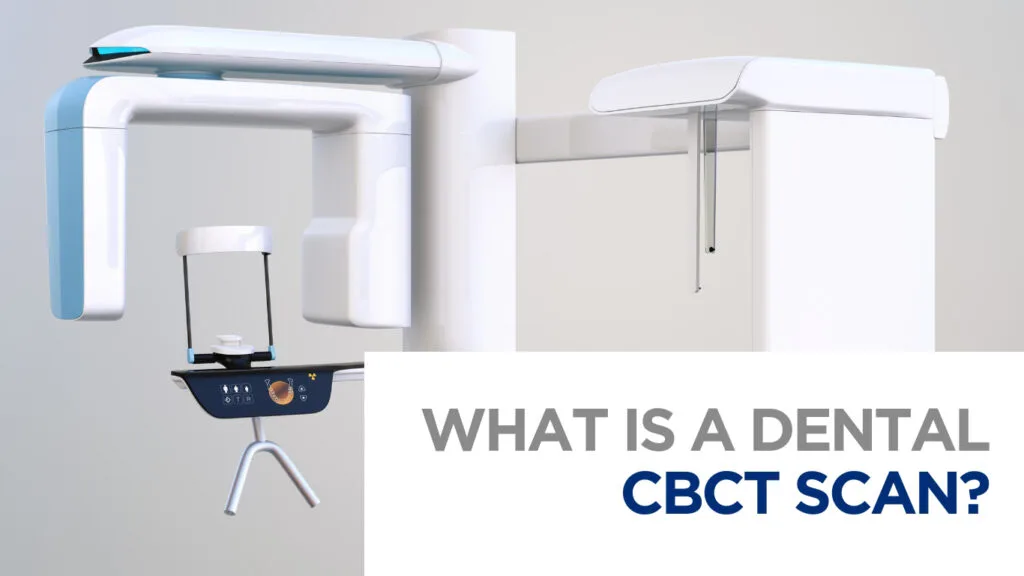
Some of the most important details in your mouth simply don't show up on a flat x-ray. That's why we keep a cone-beam CT (CBCT) scanner right here in our Kentfield office — a low-dose 3D imaging system that maps your jaw, teeth and surrounding anatomy in three dimensions. For Marin patients considering implants, oral surgery, or a complex diagnosis, it can move us from planning by estimate to planning by precise, millimeter-level measurement — without a trip to an outside radiology center.
What is CBCT 3D imaging?
CBCT stands for cone-beam computed tomography — a specialized type of CT scan designed specifically for the teeth, jaws and face. Where a traditional dental x-ray gives a flat, two-dimensional picture, a CBCT scan captures hundreds of images as the machine makes a single rotation around your head, then reconstructs them into a detailed 3D model of your anatomy. Dr. Ghaffarpour can rotate that model on screen, slice through it at any angle, and measure structures down to the millimeter.
The result is a view of things flat x-rays physically can't show: the height and thickness of your jawbone, the path of the nerves running through your lower jaw, the position of your sinuses, hidden areas of infection, impacted teeth, and the true shape and number of a tooth's roots. CBCT doesn't replace your routine dental x-rays — it's a focused tool we reach for when seeing in three dimensions can genuinely change how we plan and protect your care.
How we do it at Kentfield Dental
We invested in an in-office Vatech Green X12 cone-beam CT so this advanced imaging can be part of your regular visit — not a referral to an outside radiology center, not a second appointment, and not days of waiting for a report. When Dr. G needs a closer look, you simply stand or sit still for a quick scan that takes only seconds of actual exposure, and the 3D model is typically ready to review together within minutes. The Green X12 is a low-dose system, designed to capture this detailed three-dimensional view while keeping radiation exposure modest. Because the scan lives on the same digital platform as our 3Shape intraoral scans and MouthWatch camera images, Dr. G can merge your 3D bone anatomy with a digital scan of your teeth to plan treatment with a high degree of accuracy. That same data can flow straight into our in-house Formlabs 3D printer to produce a custom surgical guide, and into our CEREC workflow when a restoration is involved. It's the kind of all-under-one-roof, see-it-and-plan-it-today capability many Marin dental offices don't offer.
- In-office Vatech Green X12 CBCT — low-dose cone-beam 3D imaging, no outside radiology referral
- Scan, review and plan in a single Kentfield visit, often within minutes
- 3D bone data merges with 3Shape digital scans for precise, restoration-driven planning
- Feeds our in-house Formlabs printer to produce custom surgical guides for guided implant placement
- Dr. G walks you through your own 3D scan on screen, so you can see exactly what we see
Why patients choose us for this
Sees what flat x-rays miss
A 2D x-ray flattens everything onto one plane. CBCT reveals bone volume, nerve canals, sinus position and root anatomy in three dimensions — the details that help determine whether a treatment is safe and predictable.
Supports safer, more precise surgery
By mapping the location of nerves, sinuses and available bone before we begin, CBCT helps Dr. G plan implants and extractions around your individual anatomy — designed to reduce surprises and protect the structures that matter.
Low radiation dose
Our Vatech Green X12 is designed as a low-dose system, capturing a full 3D view of your jaw with a modest radiation exposure — and we only recommend a scan when the diagnostic benefit clearly justifies it.
Done in-house, same visit
No referral to an outside imaging center and no waiting days for a report. The scan happens in our Kentfield office and we review it together within minutes, so planning can often start the same day.
Clearer, more confident diagnosis
CBCT can help uncover hidden infections, fractures, impacted teeth, cysts and the source of pain that flat films leave ambiguous — turning an uncertain picture into a clearer one.
You see what we see
Dr. G rotates your 3D scan on screen and explains exactly what it shows, so you understand the reasoning behind every recommendation and stay an informed partner in your care.
What to expect
Review why a scan is needed
Dr. G first explains why a 3D view will help your specific case — whether it's planning an implant, evaluating a difficult extraction, or pinpointing the source of pain — so you understand the purpose before anything begins.
A quick, low-stress scan
You'll rest your chin on a support while the Vatech Green X12 makes a single quiet rotation around your head. The actual exposure lasts only seconds, there's nothing placed inside your mouth, and there are no goopy molds or bulky sensors.
Building your 3D model
The scanner's images are reconstructed into a detailed three-dimensional model of your jaw, teeth, nerves and sinuses — typically ready to explore from any angle within minutes, right here in our Kentfield office.
Reviewing your scan together
Dr. G rotates and slices through your 3D model on screen, points out exactly what it shows, and answers your questions — so the findings and the plan are clear and shared.
Planning your treatment
The same 3D data drives precise treatment planning — guided implant placement, a Formlabs-printed surgical guide, or a confident diagnosis — so your care is mapped before, not during, treatment.
Your comfort matters. A CBCT scan is non-invasive and quick — nothing is placed in your mouth, and the scanner simply rotates around your head for a few seconds, which most patients find easy even when they feel anxious about dental visits. Dr. G explains why a scan is recommended and reviews the results with you on screen, so there are no surprises.
Is a CBCT scan right for you?
A CBCT scan isn't part of every routine cleaning — it's a targeted tool we recommend when a 3D view can meaningfully improve the safety or accuracy of your care. Dr. G will only suggest one when the diagnostic value justifies the scan, and will always explain why. If you've been told a case is complex, or another office referred you out for imaging, this is often exactly the technology that lets us plan it here in Kentfield.
- You're considering dental implants and we need to assess bone height, thickness and nerve position
- You need a surgical extraction or wisdom-tooth removal, or have an impacted tooth
- An upper implant or extraction may involve the sinus, or you're exploring a sinus lift
- A tooth is causing pain, infection or symptoms that flat x-rays can't fully explain
- You're planning complex treatment and want it diagnosed and mapped accurately before starting
Frequently asked questions
A CBCT scan is a low-dose 3D x-ray of your teeth and jaws. Unlike a flat dental x-ray, cone-beam CT captures your anatomy in three dimensions, showing bone, nerves, sinuses and tooth roots in detail — which is why it's often the foundation for implant and surgical planning.
Dental CBCT is generally considered safe when used appropriately. Our Vatech Green X12 is a low-dose cone-beam system, and we only recommend a scan when the diagnostic benefit clearly justifies the small radiation exposure. Dr. G will always explain why a scan is needed first.
A dental CBCT scan generally uses far less radiation than a conventional medical CT scan, and our low-dose Vatech Green X12 is designed to keep exposure modest. The dose is small enough that the diagnostic value of a clear 3D view typically outweighs it when a scan is genuinely indicated.
A regular dental x-ray is a flat, 2D image, while a CBCT scan is a 3D model you can rotate and measure. CBCT reveals bone volume, nerve position, sinuses and root anatomy that flat films can't capture — so it's used for implants, surgery and complex diagnosis rather than routine checkups.
In many cases, yes. A CBCT scan lets us measure your jawbone and locate the nerves and sinuses precisely, which helps us place an implant safely and accurately. The same 3D data can feed the Formlabs surgical guide we print in-house for guided placement.
You can get it right here in Kentfield. We keep an in-office Vatech Green X12 cone-beam CT, so Marin patients don't need a referral to an outside radiology center — the scan and the review happen in our office, often in the same visit.
Most patients find a CBCT scan very easy and tolerable. You simply rest your chin on a support while the scanner makes one quiet rotation around your head — nothing goes inside your mouth, there are no molds or bulky sensors, and the actual exposure lasts only seconds.